Erik Perry · 10 September 2026
Cache Synchronization Challenges Across Multi-Region Deployments
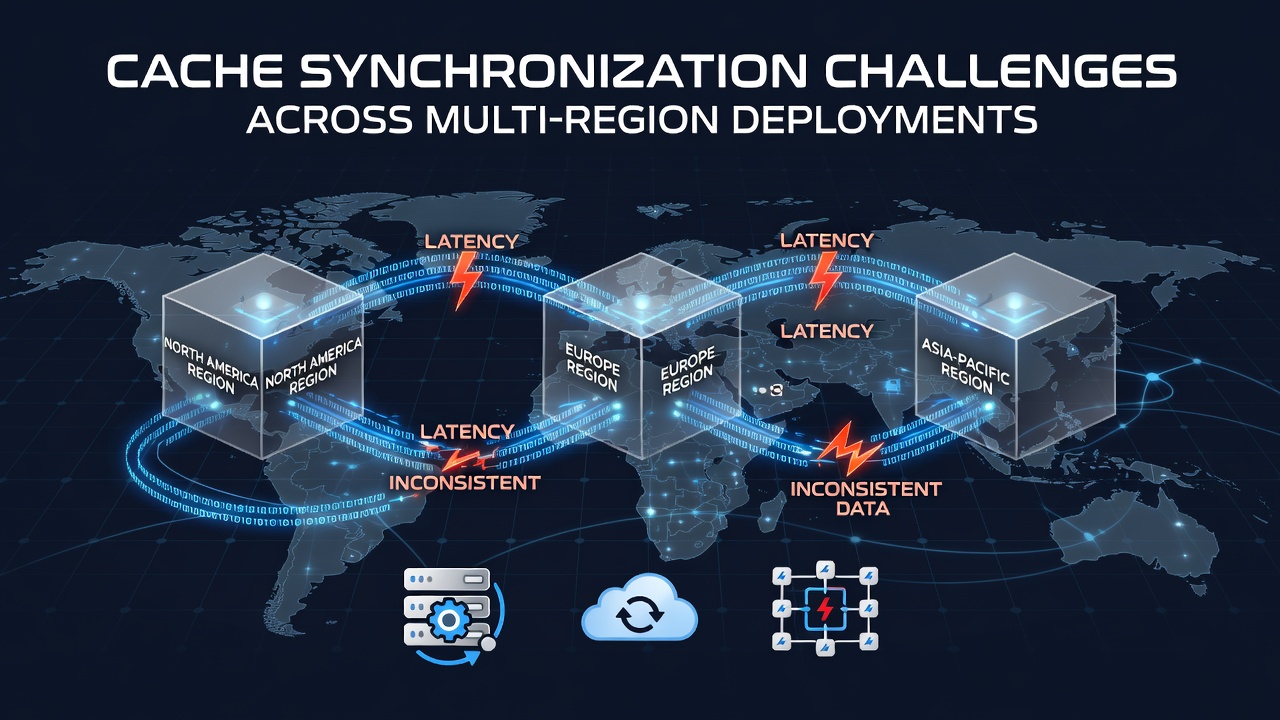
Multi-region deployments require systems to keep cached data aligned across separate geographic zones, yet network delays and partition events create persistent obstacles that teams must address through careful protocol design. Data centers located thousands of miles apart exchange updates at varying speeds, which means any synchronization mechanism has to balance speed against accuracy while handling concurrent writes from users in different locations.
Core Mechanics of Multi-Region Caching
Cache layers sit between application servers and primary databases, storing frequently accessed items to reduce round-trip times. When those caches span continents, each node holds a local copy that must eventually reflect changes made elsewhere. Observers note that systems typically adopt either strong consistency models, which block operations until every replica acknowledges an update, or eventual consistency approaches that allow temporary divergence before reconciliation occurs.
Researchers at various institutions have documented how eventual consistency reduces user-perceived latency because operations complete without waiting for distant acknowledgments, but this choice introduces windows during which different regions may serve stale values. According to publications from the National Institute of Standards and Technology, distributed systems that prioritize availability often accept brief inconsistencies rather than risk widespread unavailability during network partitions.
Primary Technical Obstacles
Network latency forms the most immediate barrier because light-speed limits impose minimum delays between regions, and packet loss compounds the problem during peak hours. Conflict detection becomes difficult when two regions simultaneously modify the same key, forcing reconciliation logic to decide which version prevails or how to merge competing changes without data loss.
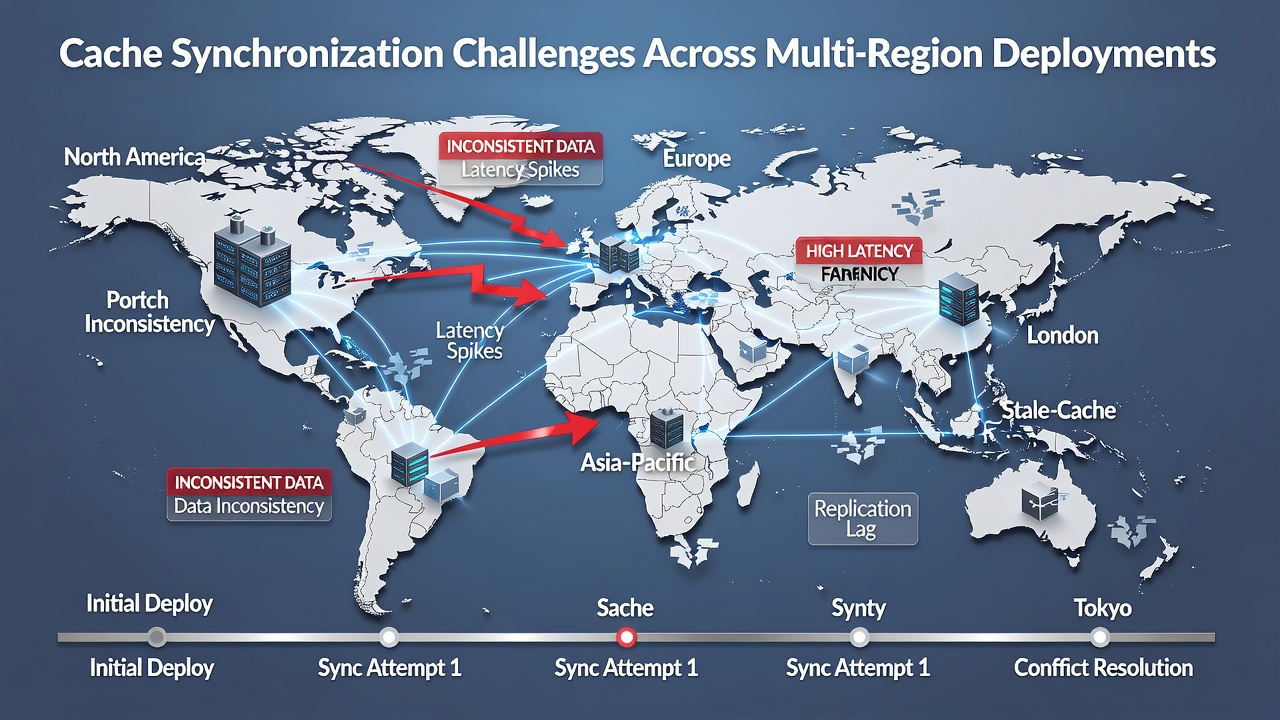
Partition tolerance adds another layer, since connectivity between regions can drop without warning and leave isolated caches operating independently for extended periods. Studies from academic sources show that recovery procedures must then replay logs or exchange delta sets to restore a unified view, yet replay order matters and out-of-sequence updates can produce incorrect results if timestamps lack sufficient precision.
Consistency Models and Trade-offs
Teams choose among several consistency guarantees depending on application requirements. Read-your-writes consistency ensures a client sees its own updates immediately, while monotonic reads prevent older values from appearing after newer ones have been observed. Each model carries implementation costs in the form of additional metadata, such as vector clocks or hybrid logical clocks, that travel with every cache entry.
What's interesting is how these metadata structures grow in size as the number of regions increases, creating storage overhead that must be weighed against correctness needs. Data from industry reports indicate that many large-scale services settle on bounded staleness windows, allowing caches to diverge for no more than a few seconds before forced synchronization runs.
Practical Approaches Observed in Production
One common pattern involves write-through caches that forward every mutation to a central authority before acknowledging the client, then propagate the change asynchronously to other regions. Another approach uses gossip protocols where nodes exchange recent updates with randomly chosen peers until information reaches every location. Both methods appear in deployments that handle global user bases, and each carries distinct failure modes when message delivery order cannot be guaranteed.
In September 2026, several major cloud providers released enhanced tooling that incorporates vector-clock compression and selective replication, reducing the bandwidth required to resolve conflicts across distant regions. These updates addressed previously observed bottlenecks where high update rates overwhelmed reconciliation queues.
Monitoring and Operational Considerations
Visibility into synchronization health requires metrics that track replication lag, conflict frequency, and recovery time after partitions. Operators collect these signals through distributed tracing systems that tag cache operations with region identifiers and sequence numbers. When lag exceeds defined thresholds, automated alerts trigger investigation into network conditions or misconfigured eviction policies.
Capacity planning must also account for the extra traffic generated by synchronization messages, especially during global events that produce sudden spikes in write activity. Figures from research papers on distributed storage reveal that synchronization traffic can reach 15 to 30 percent of total cache-related bandwidth under sustained load.
Conclusion
Cache synchronization across multiple regions remains a domain where architectural decisions directly influence both performance and correctness. Teams continue to refine protocols that minimize divergence windows while respecting the physical constraints of global networks. Continued advances in clock synchronization and conflict-free data structures offer pathways to reduce the operational burden, yet the fundamental tension between latency and consistency persists as deployments scale.